
This is a TBL lesson designed for a pair of students taking Business English classes. The students work together in a multinational company in Brazil and would like to progress to more international roles that involve using English at meetings, with clients, emails, reports and other company processes. This lesson comes after TBL Lesson #7. If you haven’t read that one I suggest you do so you know where we are coming from!
Las class I assigned some homework to my learners. I thought it was time to start reviewing the language we worked on so we could recycle it more often in class and in between classes. I sent students the following message in our WhatsApp group:
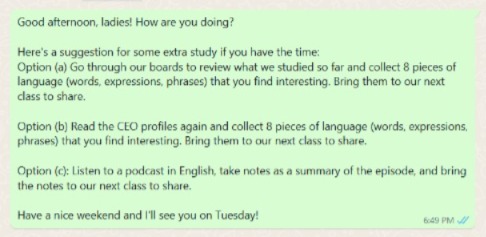
“Good afternoon, ladies! How are you doing?
Here’s a suggestion for some extra study if you have the time:
Option (a) Go through our boards to review what we studied so far and collect 8 pieces of language (words, expressions, phrases) that you find interesting. Bring them to our next class to share.Option (b) Read the CEO profiles again and collect 8 pieces of language (words, expressions, phrases) that you find interesting. Bring them to our next class to share.
Option (c): Listen to a podcast in English, take notes as a summary of the episode, and bring the notes to our next class to share.
Have a nice weekend and I’ll see you on Tuesday!”
We keep all our board and class notes in a Google Drive folder so students can access them more easily. I usually give adult learners choices such as the ones above because I feel it gives them some more agency and responsibility over their learning. Notice also that there are choices to be made within the choices A, B and C (choiceinception!). I believe this further adds to learner autonomy and agency over what language to explore and bring to class.
We began this lesson by going over their homework. Joana (fake name) chose option C and talked to us about what she got from the podcast she listened to. The podcast was about international news and politics and closely related to their work in lobbying. She highlighted some words and expressions she found interesting. I wrote these on the board, and we worked on their meaning, form, use, and pronunciation.
Maria (fake name) chose option B. She read the CEO profiles again and brought to class some interesting language to be discussed. I elicited the words from her, wrote them on our board, and worked on meaning, form, use, and pronunciation.

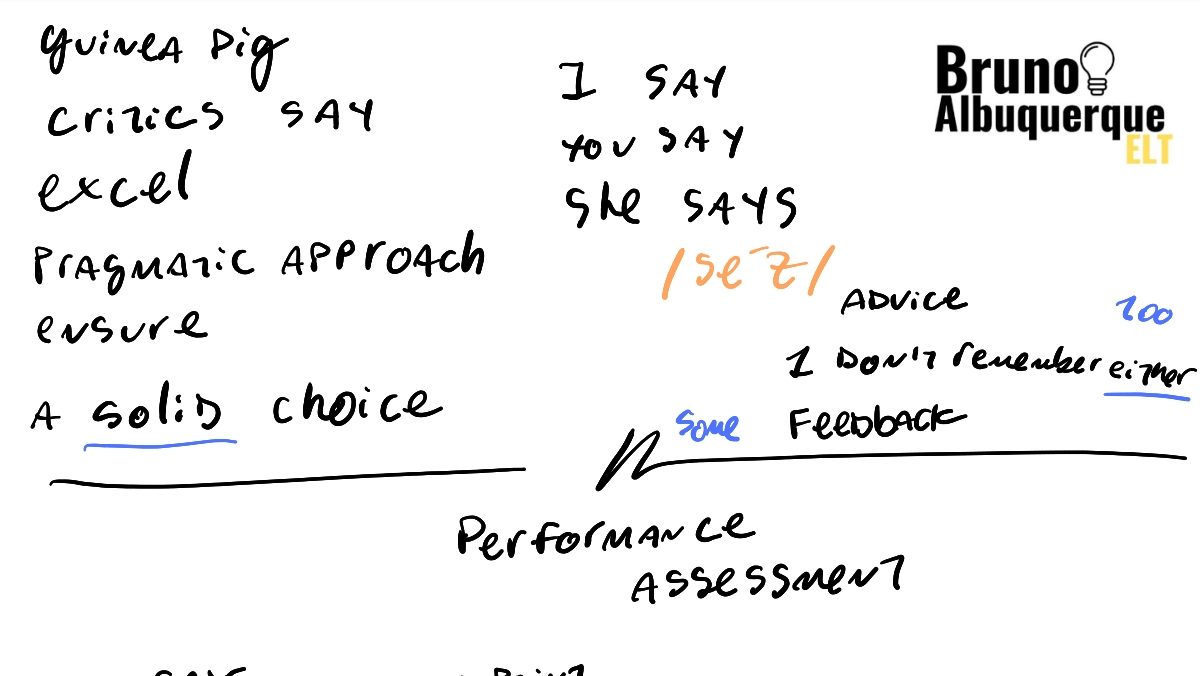
When we were done dealing with the homework, we began talking about our next topic of interest: performance reviews. I asked students what they thought about the performance reviews at their work and we had a little chat on the topic. I took some notes and then we worked on some emergent language.
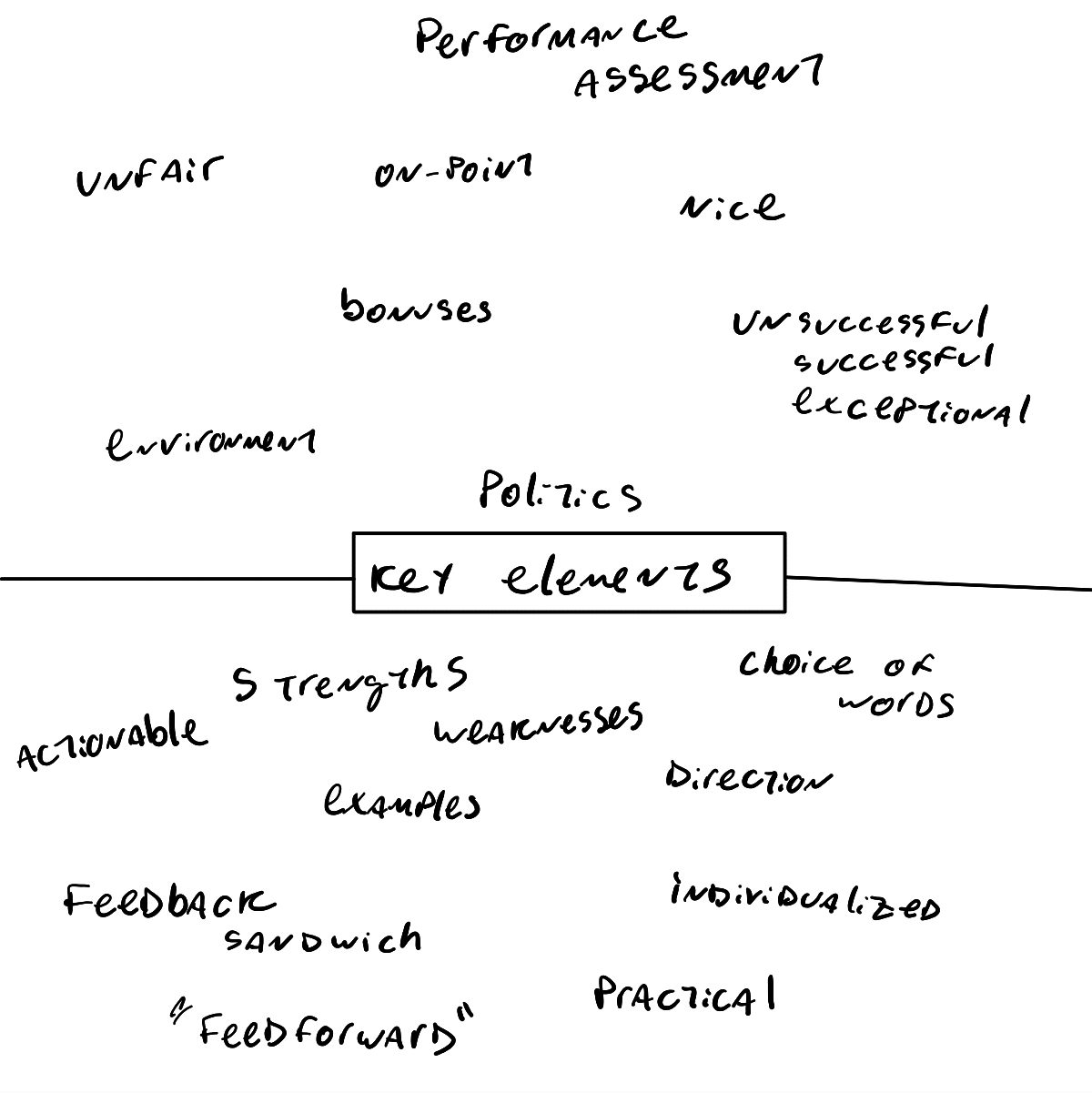
To wrap up the lesson, I told them we would build a mindmap about the key principles in performance reviews. This was a task I participated in by asking follow-up questions and mediating the conversation to keep it going for as long as possible. They added some items to the mindmap and we wrapped up the discussion. We worked on some emergent language and I gave them some feedback.
For homework, I told them to read a set of performance review criteria I created with DeepSeek and take notes on the strengths and weaknesses of each set of criteria. This is the prompt I wrote:
Hey Deep! You know I’m an English teacher and that I like working with task-based learning. I’m teaching a pair of students focusing on Business English. They work in lobbying in a company called Whirlpool who sells appliances to government departments here in Brazil.
I’d like you to create 4 sets of criteria for a Whirlpool employee yearly performance evaluation. The sets cannot be excellent because the goal of this task is to talk about the sets and decide on the best one, the one that is the most fair. Each set of criteria should have at least 7 criteria and be evaluated from below standard – to standard – above standard
And this is what the AI created (click here!).
In the next class, we are going to talk about the sets and decide on the best one to be used in their yearly evaluation.
See you next class!


 ELT in Brazil
Leave a reply to Performance Assessment Criteria – TBL Lesson #12 – Bruno Albuquerque ELT Cancel reply