Today I taught another lesson under the TBL approach, this time for a group of beginners. There are two students in this group and they are studying English for no particular reason – they just want to study the language in case they need it in the future. Both students are beginners, not real beginners though. One of them communicates at word level and the other one can string together a couple of words.
This is clearly a class that needs more input-focused tasks before moving on to output-focused tasks. Also, to ensure they’re able to perform well, I decided to use a here-and-now, focused, closed task. The task I’m about to describe is an input-focused, here-and-now, focused, closed task.
It is input-focused because the students are not necessarily required to produce language. This is not to say they won’t (as you’ll see, they did produce language during the task), but input-focused tasks are reading and/or listening tasks aimed at providing students with language they can acquire so they can use it in future output-focused tasks.
It is a here-and-now task because it focuses on something in the present and concrete, as opposed to a there-and-then task that might be situated in a different time and be abstract.
It is a focused task because I aimed to look into a specific lexical group and grammar to describe the location of things in a bedroom. An unfocused task would have no hidden agenda as to the linguistic focus.
It is a closed task because there is a set expected outcome – drawing my bedroom as accurately as possible. An open task would have no set expected outcome.
Here is the lesson plan:
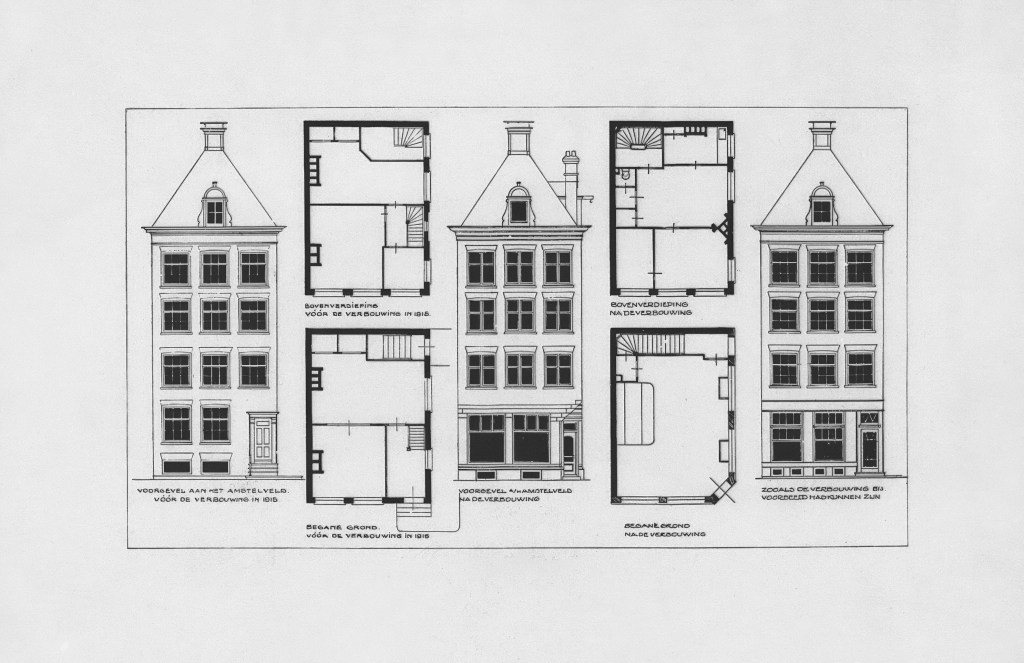
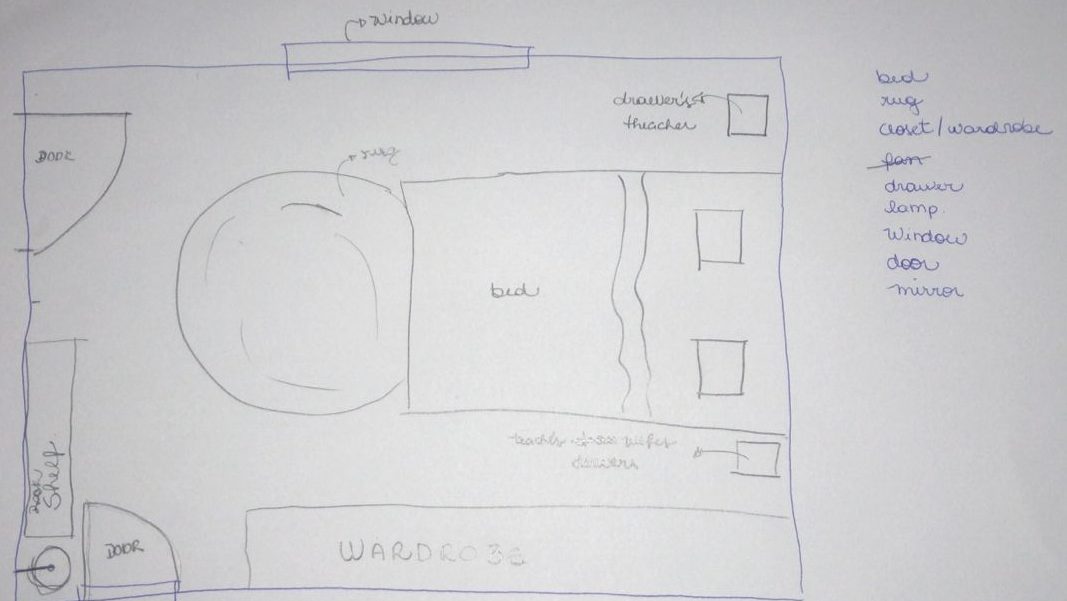
I drew my bedroom as seen in the second image below and shared the first image with the students. While looking at the first image, I asked them “What do you think this is?” and after a couple of tries, they got it right (your bedroom!).

At this point, I elicited bedroom objects and the students came up with some or asked (how do you say ‘tapete’ in English? – Rug.).
Then, I told them I was going to describe my bedroom and that they were supposed to draw it in their notebooks. I used the door on the first image as a reference point to begin describing the bedroom. Students asked me to repeat and clarify a couple of times during the task. They asked questions such as Where, teacher? The right wall? Center? In front or next? and I responded accordingly. At the end of the description, which took around 25 minutes of language-rich, interactive input, I described everything again so they could check their drawings.
Finally, I asked them to send a picture of their drawings to our WhatsApp group so we could check. You’ll find their drawings below.

For homework, I asked them to draw their bedrooms in simple terms like I did and plan and prepare to describe them in the next class. The task will become an output-focused task for the student describing the bedroom which seems to be an adequate, scaffolded next step in this sequence. I will ask the more proficient student to begin to further provide a model to the student at word level proficiency.
What do you think of this lesson? Would you use it with your students?


 ELT in Brazil
Leave a reply to Not quite my bedroom – TBL Lesson #5 – Bruno Albuquerque ELT Cancel reply