The principles of DOGME have always resonated with my teaching philosophy. Conversation-driven, materials-light lessons that focus on emergent language became the norm since I started to work independently of a school, in which I had to follow the synthetic grammar syllabus of coursebooks. If you are in this situation, click here for ten ideas on how to teach better with a coursebook.
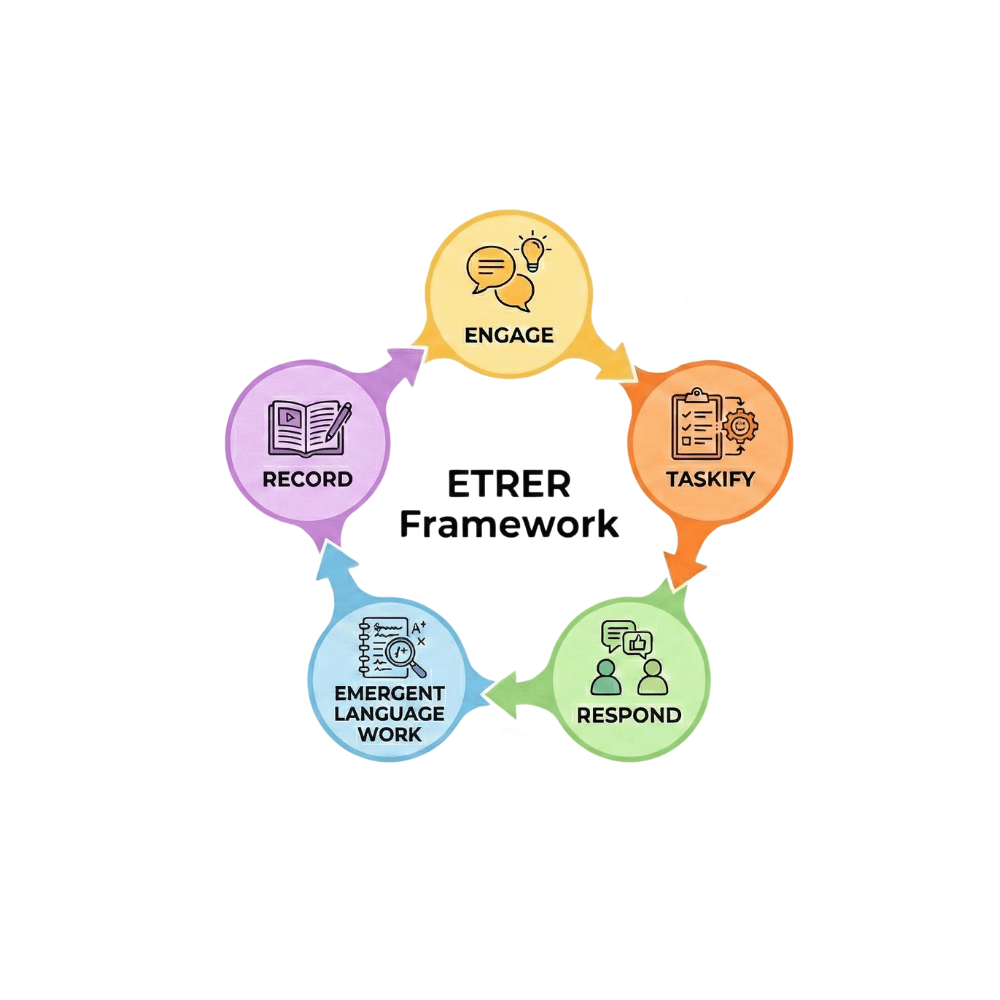
The issue with principles alone, I reckoned, is that they do not provide pedagogical principles, only methodological ones. This means that the whys have been clear for a while, but not necessarily the how. After experimenting for a couple of years, I noticed that many of my lessons seemed to take a similar shape. This shape, or framework, is described and explored below.
Engage
This is a stage where the teacher will engage with learners and their immediate needs. This stage is usually a short conversation to try to get from the learner a topic that is relevant to them, to design the lesson around it. With more advanced learners, the teacher can stir the conversation in a way to bring to the table topics that will elicit more sophisticated language.
Taskify
In this stage, the teacher will have selected, with the learner, a topic for the lesson. This topic should then be taskified in order to build an information, reasoning, or opinion gap and give learners a reason to communicate, negotiate meaning, and collaborate to complete the task. The teacher can turn the topic into a task by asking learners to list, rank, sequence, categorize, problem-solve, compare, design, plan, evaluate, decide, choose, negotiate, and more. As learners perform the task, the teacher should interact and take notes in one-to-one lessons or just listen and take notes in group lessons.
Respond
When the learners are done performing the task, the teacher and the learners themselves should respond to the task performed. This stage acts as a wrap-up of the task done, similar to Willis’ report stage. Learners will talk about the task process, and the result of the task they worked on, and the teacher will respond to their performance, focusing on task achievement and interactive competence.
Emergent language work
This is the moment for the teacher to work on the language that emerged during the task. The teacher must write down in their notes not only grammatical mistakes, but also interesting pieces of language produced by the learners, instances where they could have been more precise, different ways to say the same thing, possibilities to expand on ideas, pronunciation issues, and non-salient features of language that might go unnoticed. Of course, after dealing with this language, the teacher should also help learners with any mistakes and corrections. (Click here for more on Emergent Language)
Record
Finally, there should be a record of the lesson once it is done. Learners can keep a language learning journal, record a voice message, or write a short paragraph summarizing the lesson. Ideally, the learners should keep this material in their portfolio alongside their journal, self-assessment questionnaires, and other authentic assessment tools.
Here’s an example:
| Engage | Ask learners about their relationships with their neighbors and what they consider to be “good” or “bad” neighbors. Allow them some time to discuss their experiences. |
| Taskify | Ask learners to collaboratively design five rules of conduct for members of their community. If possible, group learners according to where they live (apartment building, street, gated community, etc.). |
| Respond | Once learners have finished, ask them to share their rules with the class and identify how different living situations require different or similar rules. Ask follow-up questions and comment on their ideas. Conduct a brief reflection by asking what they struggled with during the task, what they found easy, and what they would do differently next time. |
| Emergent Language | Provide feedback on the learners’ language use. Show them how they could have expressed their ideas more precisely, in more detail, or in a more sophisticated and natural way. Then, help them correct specific errors, particularly those that do not hinder communication and might otherwise go unnoticed. |
| Record | Ask learners to write a short paragraph justifying their rules. Encourage them to incorporate the language and expressions explored in the previous stage. Keep this in their portfolios. |
Click here to find the lesson above with some commentary and a template you can use for planning.
Acknowledgments:
This framework is also vastly inspired by the amazing work shared by Dylan Gates, Sam Gravell, and Cecilia Nobre on LinkedIn. Click their names for their profiles.

 ELT in Brazil
Leave a comment