
If you’ve been following my posts for some time with lesson ideas, some tasks, and at times full lesson plans, you might’ve noticed that in all of them I talk about ‘working with emergent language’ – but what does that mean, really? (btw, I wrote that em dash, this is no AI. ugh…)
What is Emergent Language?
Emergent language is easily understood when we oppose it to target language. Target language is the grammar, vocabulary, or finer features of language that the teacher decides to teach their students before going into class. Having this target language in mind, the teacher will plan a lesson to scaffold and focus on those 8 words they decided to teach the students in that lesson.
When you’re dealing with emergent language, that doesn’t happen. You might’ve noticed that in the lesson ideas, tasks, and TBL lesson plans I share here do not involve a vocabulary list to be taught or a specific grammar point to be focused on, right? That’s because the decision here is to allow students to engage with the task with their own linguistic repertoire and, based on their performance, decide what to teach. The goal of this type of class is not to teach a vocabulary list or a specific grammar point – but to help students communicate better. Notice also that ‘communicate better’ can mean a myriad of things: better pronunciation, more natural connected speech features, more eye contact, more backchanneling, turn-taking, tone, choice of words, and yes, grammatical accuracy.
How do you work with emergent language?
To be able to work with emergent language, one must first know how to take effective notes during the lesson. It is common for teachers to take notes during class and focus on students’ grammar mistakes to be addressed in a delayed feedback session, usually by the end of a lesson. To work with emergent language, however, the teacher should take notes of:
(1) interesting language used by the students;
(2) instances where the student could’ve said something in a more natural way;
(3) interesting phrases that can be expanded;
(4) vocabulary that can be made more precise;
(5) pronunciation features that might’ve gone unnoticed;
(6) mistakes students made.
Look at the notes below. These were taken during a language development course with some English teachers I’m working with this semester:
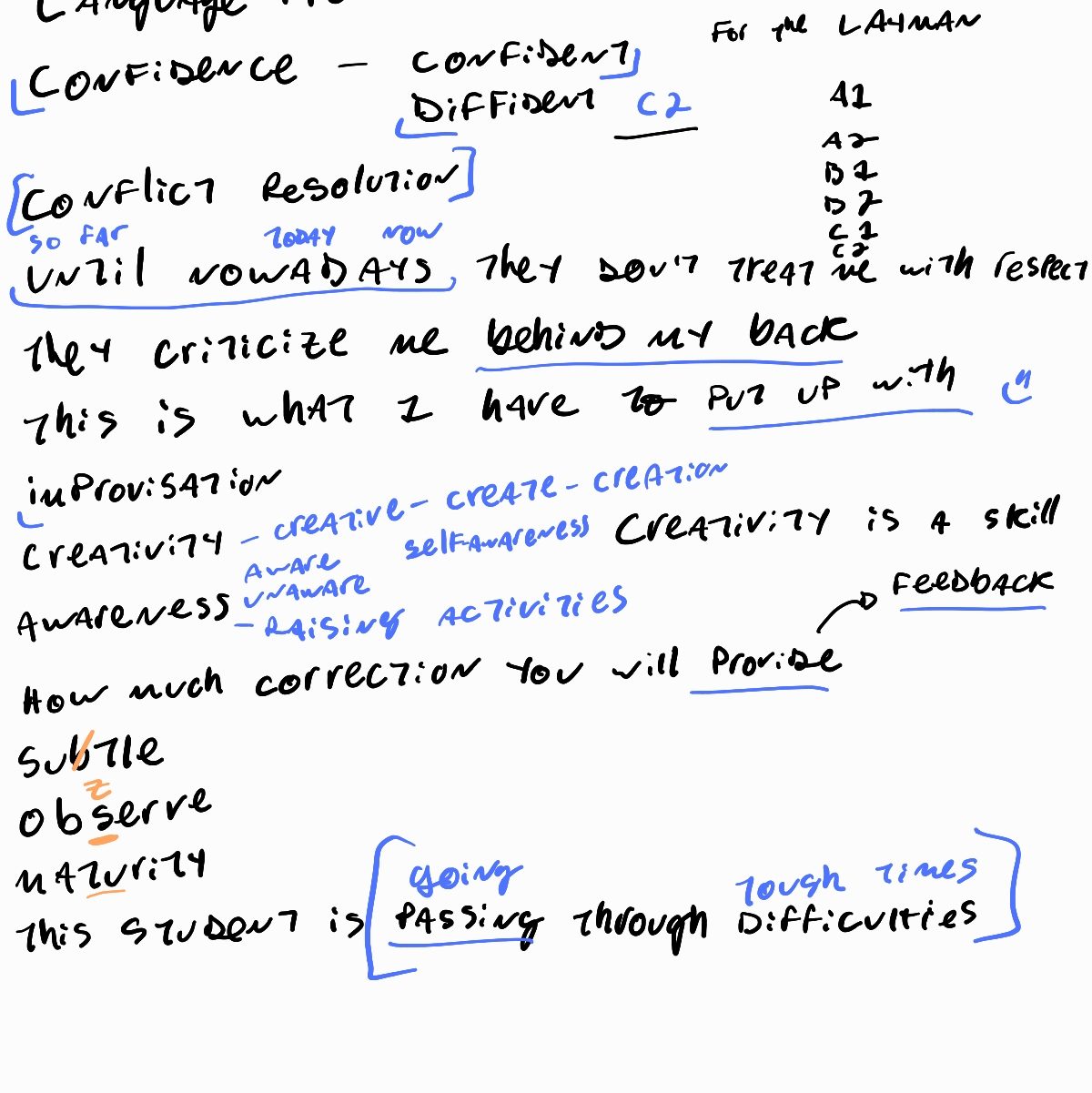
Here’s how I worked with this language with my students:
(1) “confidence”, “conflict resolution”, “behind my back”, “put up with”, “improvisation”
These are examples of interesting language the students produced during the lesson. I wrote them down to praise them for the use of these and to encourage them to use them more often. I feel this kind of positive feedback can help students become better risk-takers when it comes to language use and creativity.
(2) “for the layman”, “going through difficulties”
These were notes I took of things students could’ve said better. The students did not produce layman but wanted to, and then said “this student is passing* through difficulties” when it would be more natural/frequent to say “tough times”.
(3) and (4) “confident”, “diffident”, “creativity”, “awareness”, “feedback”
These are some words students said that I thought it’d be a good idea to expand. I expanded by providing some synonyms, antonyms, collocations, and playing with word formation a bit.
(5) “subtle”, “observe”, “maturity”
These are words the students might’ve pronounced correctly or not, but words I feel we should notice their pronunciation a bit more explicitly. I like to show students silent letters, features of connected speech, and some unusual pronunciation.
(6) “passing through*”, “feedback students*”, “until nowadays*”
Finally, this is the moment I correct mistakes. I usually help students analyze what they said and come up with the correct form themselves, or sometimes just provide the correction and move on. It is important to note, however, that this is not the only moment of correction during the class. Throughout the task, I will recast what students have said to provide them with some instant feedback on what they are saying as well.
Finally, if you’d like to learn more about working with emergent language and how to structure your classes around it, consider joining our WhatsApp Community or our courses on TBLT and DOGME ELT.


 ELT in Brazil
Leave a comment